
Sunrise Express vs. Amtrak Overnight Trains: Why Japan's Last Sleeper Train Wins

If you've ever searched for overnight trains in Japan, you've probably landed on the Sunrise Express: the last regularly scheduled sleeper service running in the country. It's two trains in one, the Sunrise Seto and the Sunrise Izumo, coupled together for much of their journey before splitting at Okayama to reach Takamatsu and Izumoshi respectively.
It's genuinely one of the best overnight train experiences in the world. But to understand why, it helps to compare it to what overnight trains look like on the other side of the Pacific.

The California Zephyr: Two Days, No Guarantees
The California Zephyr is, by any objective measure, one of the most beautiful train journeys in the world. Departing Chicago in the afternoon, it rolls through the Rockies, cuts across the Utah desert, crests the Sierra Nevada, and descends into the San Francisco Bay Area: 2,438 miles of genuinely stunning scenery.
It also takes about 52 hours. That's not a typo. Two full days and nights on a train.
The structural reality of American rail makes this worse than it sounds. Amtrak doesn't own most of the tracks it runs on. The California Zephyr shares corridors with BNSF and Union Pacific freight operations, and freight trains take priority. Delays aren't the exception; they're built into the journey. Booking the Zephyr before a tight connection is widely considered inadvisable, and on-time performance rarely clears 50% when measured at passengers' destination stations.
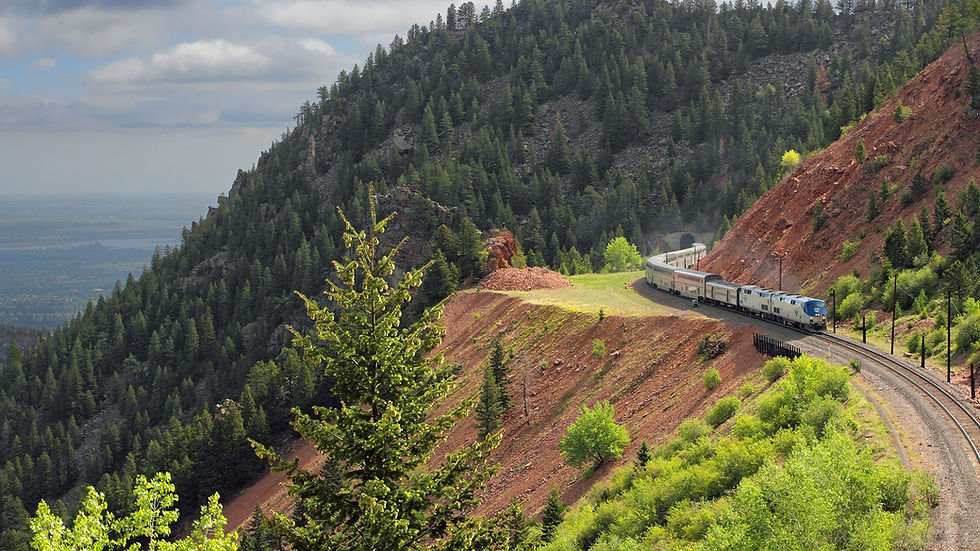
To be fair, the Zephyr was never designed to compete with flying. It's a scenic experience first and foremost, and it delivers on that. Plenty of Americans ride it specifically to unplug, watch the country roll by from a lounge car, and arrive two days later having seen something. If that's the goal, it's excellent.
But if you need to actually be somewhere, it's not the tool for the job.
The Empire Builder: Amtrak's Most Popular Train, and Its Most Delayed
If the California Zephyr is America's most scenic overnight train, the Empire Builder is its most iconic. Running from Chicago to Seattle and Portland through the northern Great Plains and the Cascade Range, it covers over 2,200 miles of genuinely dramatic landscape and carries more passengers annually than any other Amtrak long-distance route.
It's also, by the numbers, a scheduling nightmare.
The Empire Builder runs almost entirely on BNSF Railway tracks, one of the busiest freight corridors in North America. Freight interference is the dominant cause of delay, and the data is not flattering: in March 2026, the Builder's customer on-time performance dropped to just 49.6%, meaning more than half of passengers arrived late. BNSF-caused delay minutes nearly doubled month-over-month, from 489 to 803 minutes per 10,000 train miles. In August 2025, one eastbound departure out of Seattle was spotted running 13 hours and 29 minutes late in North Dakota, after a borrowed BNSF freight locomotive was pressed into service because it couldn't reach the required 79 mph passenger speed.

Mechanical failures compound the problem. Locomotive breakdowns in the middle of Montana at 2 AM are not hypothetical; they're documented regularly in Amtrak's own service alerts. On at least one occasion in early 2025, an entire round trip was cancelled after cascading delays made the outbound equipment impossible to turn around in time.
The Empire Builder offers incredible scenery through Glacier National Park and the Cascades, and a sleeper compartment on it is a genuinely special experience. But anyone catching a flight out of Seattle or Portland after riding it is playing the odds.
The Sunrise Express: Overnight Train as Practical Infrastructure
Japan operates under an entirely different set of assumptions. The Sunrise Express -- the Sunrise Seto to Takamatsu and the Sunrise Izumo to Izumoshi -- departs Tokyo every night at 10:00 PM and runs south and west through the night on JR-operated main lines.
The longest journey, Tokyo to Izumoshi, clocks in at just under 12 hours. Tokyo to Osaka, for eastbound passengers boarding at Osaka's stop just after midnight, is a little over six. These aren't multi-day expeditions. They're overnight hops, timed to deliver you somewhere useful at a reasonable morning hour.

The difference in track priority is fundamental. In Japan, passenger rail is given precedence. The Sunrise runs on infrastructure where punctuality is a cultural baseline, not a marketing aspiration. Japanese rail on-time performance is measured in seconds. Freight doesn't bump passengers. There are no BNSF-style freight corridors slowing down the schedule and no borrowed freight locomotives limping across the mountains at reduced speed.
This matters enormously for how people actually use the train. The Sunrise Express carries a mix of tourists and business travelers: people who need the train to arrive on time because they have somewhere to be afterward. That's a use case Amtrak's long-distance network simply cannot serve reliably.
The Time Advantage Nobody Talks About
Here's where the Sunrise Express goes beyond just being a better overnight train and starts competing with faster alternatives entirely.
Take the Osaka to Tokyo corridor. The Sunrise Seto stops at Osaka Station at 12:34 AM and pulls into Tokyo Station at 7:08 AM. You board in the middle of the night, sleep, and arrive in the center of Tokyo before most of the city has had breakfast.
Now consider what it takes to beat that by Shinkansen.
The first Nozomi from Shin-Osaka departs at around 6:00 AM and arrives in Tokyo at approximately 8:20 AM. To catch it comfortably, you need to be awake by 4:30 AM at the latest, dressed, fed, and out the door in the dark. You arrive at Shin-Osaka to find the concourse already filling with other early travelers, grab a platform spot, and then spend the next two and a half hours sitting upright in an open carriage while Japan scrolls past outside. It's a great train. But you're tired, you're in a standard seat with strangers on either side, and you walk into Tokyo over an hour after the Sunrise Express has already delivered its passengers to the same station.

On the Sunrise Seto or Sunrise Izumo, you have a private compartment. The single and twin cabins are compact but genuinely comfortable: your own bed, your own door, and nobody reclined into your knees. You board at midnight, you sleep, and you wake up somewhere around Yokohama with the sun coming up. By the time the Nozomi crowd is still staring at their phones in the pre-dawn quiet of Shin-Osaka, you're already an hour away from Tokyo.
Flights are even less competitive than they look on paper. Osaka Itami to Haneda has early departures from around 6:20 AM, with arrivals from 7:40 AM onward. But getting from central Osaka to Itami takes 40 to 50 minutes by monorail, which means leaving your hotel around 5:00 AM. Then check-in, security, boarding. Then landing at Haneda and taking the monorail or Keikyu Line into central Tokyo, another 30 to 40 minutes. A 7:05 AM departure from Itami realistically puts you in central Tokyo around 9:30 AM, over two hours after the Sunrise Express has already put you at Tokyo Station.
And Tokyo Station is the point. Not a peripheral airport, not a shuttle bus connection: the literal center of the city's rail network. You walk off the train and you're already where you need to be.
For a business traveler, this is a saved hotel night, a saved alarm clock, and an arrival that doesn't require you to be half-asleep on the Yamanote Line at 9:45 AM wondering if you forgot your laptop charger.
Not Just for Tourists
The Empire Builder and the California Zephyr have their audiences: people with time on their hands, a love of scenery, and no hard deadline at the other end. That's a legitimate market, and both trains serve it well.
The Sunrise Express, both the Sunrise Seto and the Sunrise Izumo, serves a much broader range of travelers. Yes, the experience is memorable. The Nobi-Nobi seats are comfortable for a night, and the private single and twin compartments are genuinely good value compared to a mid-range Tokyo hotel.
But the train also carries people who simply need to get from western Japan to Tokyo, or from Tokyo to San'in, without wasting a day. Students, business travelers, people connecting to early morning flights out of Haneda: all of them benefit from a train that runs on time, arrives in the city center, and doubles as a night's accommodation.
That's the core difference between overnight trains in Japan and their American counterparts. In America, a long-distance overnight train is a tourism product with some practical passengers along for the ride. In Japan, the Sunrise Express is infrastructure that happens to also be a great experience.
If this article interests you in taking the Sunrise Express -- click here to learn more and make a reservation today!


Comments