
What Is There to Do in Izumo, Japan? Part 1: Izumo Taisha, Shinmon-dori, and the Beach Where Myths Begin

Izumo, Japan sits outside the Shinkansen network entirely. There is no bullet train station here, no quick connection from Tokyo, no easy way to fly in and out in half a day. That is part of why Izumo stays quiet compared to Kyoto or Nara, and part of why, when I finally went, I chose to get there the way most travelers do not: on a sleeper train, asleep for almost all of it

This is the first post in a three-part series covering a one night, two day trip through Izumo, Lake Shinji, and Matsue. This part covers the overnight journey on the Sunrise Izumo and a full day exploring things to do in Izumo, centered on Izumo Taisha, the shrine where, once a year, all of Japan's gods are said to gather.
This is one of the most common questions we hear: someone wants to ride the Sunrise Express, often specifically the Sunrise Izumo rather than the Sunrise Seto, because it is the longer of the two routes and means more time on the train itself. They are sold on the train. What they have not worked out yet is what to actually do once they step off it at Izumo-shi Station the next morning. The train is the easy part to plan. What happens after is the part this series is meant to answer, starting with a full day in Izumo itself.
Sunrise Izumo vs. Shinkansen vs. Flying: The Real Math on Getting to Izumo
Izumo sits on the San'in coast of Shimane Prefecture, on the far side of the mountain range from the Sanyo corridor that most Japan itineraries stick to. There is no direct Shinkansen line out here, so every option from Tokyo involves a real time cost. Here is what each one actually looks like, door to door:
Method | Time (one way, door to door) | Pros | Cons |
Flying | About 4 to 6 hours | Shortest flight time in the air | Real time cost hidden in airport transfers; daytime only; eats into your trip on both ends |
Shinkansen + limited express | About 7 to 7.5 hours | No flights to book; flexible departure times throughout the day | Longest seated travel time; daytime only; one mandatory transfer at Okayama |
Sunrise Izumo sleeper train | 12 hours and 34 minutes | Zero daylight lost; private berth doubles as a hotel room; only sleeper train left in Japan | Longest total time on the clock; incredibly popular and therefore difficult to book |
Twelve hours sounds like the slowest option on paper, and by the clock, it is. But it is the only option of the three that costs you zero daylight. Flying and the Shinkansen both eat into a travel day on both ends of the trip. The Sunrise Express runs while you sleep, so you board after dinner in Tokyo and step off the train in Izumo with the entire day still ahead of you. Over a short trip, that is the difference between losing a full day to transit and losing none.
What It Is Actually Like to Ride the Sunrise Izumo
I booked a Single (Second Class) room, the standard Second Class private berth on the Sunrise Express, a relatively small room with a desk, alarm clock, radio, and a sliding door that locks. It is not large, but it is genuinely private, and once the train leaves Yokohama and the other passengers settle in the whole train goes quiet. The gentle rocking made sleeping easier than I expected on an overnight train in Japan.
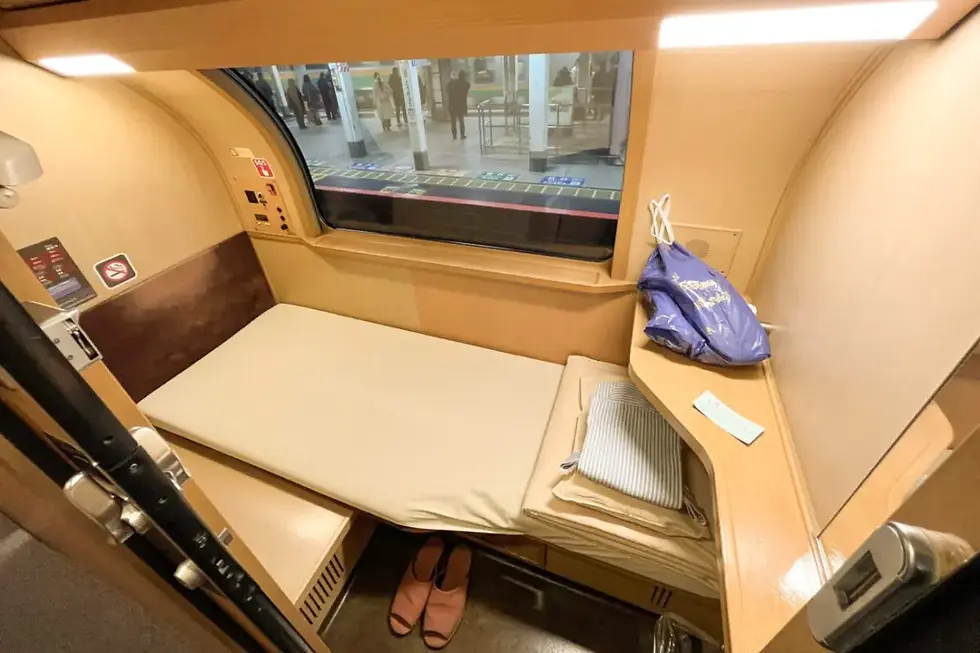
It was June, so sunrise came early. I was up around 5 a.m., not because I had set an alarm but because the light through the window was too good to sleep through. The train was somewhere past Osaka by then, running west through the Chugoku countryside, and the rice paddies on either side were still silvered with morning dew, lit gold as the sun came over the hills. I watched most of that stretch with the blind up and a coffee from the platform vending machine I had grabbed back at Okayama. It is the kind of view you only get from a train moving slowly enough, and early enough, to actually see it, not from a plane window or a blur of Shinkansen scenery.

By around 10 a.m. I was standing on the platform at Izumo-shi Station, having slept in my own bed for most of the trip and lost no daylight to transit at all. That trade, a night's sleep in exchange for a full travel day back, is the real case for choosing the Sunrise Izumo over flying or the Shinkansen, more than the novelty of riding Japan's last sleeper train.
Izumo Taisha: Where the Gods Convene
From Izumo-shi Station, I boarded the Ichibata Railway and rode about 20 minutes north to Izumo Taisha, officially Izumo Ōyashiro and, by most accounts, the oldest Shinto shrine in Japan, older than Ise.
The shrine is dedicated to Ōkuninushi, the deity credited in the Kojiki and Nihon Shoki with developing the land of Japan before ceding rulership to the descendants of the sun goddess Amaterasu. This is the kuni-yuzuri, or "transfer of the land," myth. In exchange, Ōkuninushi was given dominion over the unseen, spiritual world and a shrine equal in scale to his former rule. That shrine is Izumo Taisha, and the bargain is the reason Ōkuninushi is worshipped today as the god of en-musubi, the binding of relationships, marriages, and human connection generally.

The current Honden (main hall) stands 24 meters tall, the tallest shrine building in Japan, built in 1744 in the taisha-zukuri style, a form of shrine architecture older than the influence of Buddhist temple design. It used to be far taller still. An early Heian period record describes a structure roughly 48 meters high, and in 2000, archaeologists found the remains of enormous buried pillars that lend some support to that claim. In front of the Kagura-den hall hangs one of the largest shimenawa (sacred straw ropes) in Japan, 13.5 meters long and weighing around five tons.
The detail that actually changes how a visit feels, though, is this. Every year, in the tenth month of the old lunar calendar, which lands closer to November than the modern October most casual write-ups assume, Shinto tradition holds that every god in Japan leaves their home shrine and travels to Izumo Taisha. For one week, called Kamiari-sai, they are believed to convene here to decide the fates, marriages, and harvests of the coming year. Because of this, the rest of Japan calls that month Kannazuki, "the month without gods," while in Izumo alone, it is Kamiarizuki, "the month with gods." The gods are said to arrive first at a beach a short walk from the shrine (more on that below), then process inland along a route still called the Kami Mukae Road.
Beyond the main hall, the shrine grounds hold a network of smaller subsidiary shrines housing other deities, worth wandering through rather than rushing past, since several are tied to specific blessings (good harvests, safe childbirth, protection at sea) distinct from Ōkuninushi's own.
Shinmon-dori: The Street Outside the Shrine
The approach to Izumo Taisha is a roughly 700-meter stretch called Shinmon-dori (神門通り), "Sacred Gate Street," named for the gate at the shrine end of it, not (as I had assumed before checking) "new gate." It runs from the large stone torii at Uga Bridge up to the shrine's entrance, and it is lined with something like 60 shops and restaurants.

This is where to eat. Izumo is known locally for a few specific dishes:
Izumo soba: a darker, stronger flavored soba than you will find elsewhere in Japan, the result of milling the buckwheat with its husk still on. The classic way to order it is warigo soba, served chilled in three stacked lacquered bowls.
Zenzai: a sweet red bean soup with mochi, which Izumo claims as its place of origin.
Uzuni: a traditional fugu (pufferfish) dish particular to the region.
Tempura and sashimi are easy to find as well, usually as part of a set lunch at one of the older restaurants along the street.
Shinmon-dori is also the place to pick up en-musubi souvenirs, including matchmaking charms and chopsticks you can have engraved on the spot, since the whole street leans into the shrine's reputation for relationships.

Shimane Museum of Ancient Izumo
A short walk from the shrine's east side is the Shimane Museum of Ancient Izumo, and it is worth the detour even on a tight schedule. The centerpiece exhibit is 358 bronze swords, excavated together at the nearby Kojindani site in 1984 and 1985, a number that on its own exceeded the total count of Yayoi period bronze swords found anywhere else in Japan up to that point, combined. They were found buried in four neat rows, blades up, almost certainly for ritual rather than practical use, since none were ever sharpened. Alongside the swords, the museum also displays the excavated base of the giant pillars that may have once supported the original 48-meter-tall Izumo Taisha, plus a 1/10-scale model of what that structure might have looked like.

Inasa-no-Hama: The Beach Where the Gods Arrive
About a 15 to 20 minute walk from the main shrine, or just a few minutes by car, is Inasa-no-Hama, a beach on the Sea of Japan. It is an easy, unhurried walk from the shrine grounds, and worth doing even without the mythology, since it is a genuinely good stretch of coastline. With the mythology, it is something more.
Inasa-no-Hama is the setting for the kuni-yuzuri myth mentioned earlier. The negotiation over the transfer of Japan's rulership from Ōkuninushi to the heavenly gods is traditionally placed on this stretch of sand. It is also where, every Kamiari-sai, the visiting gods are believed to arrive by sea before processing on to the shrine. A small offshore rock called Bentenjima marks the spot.

It is worth being precise about a story that often gets blended in here. The white rabbit statues scattered around Izumo Taisha's grounds are not from an Inasa-no-Hama legend. They commemorate a separate myth, Inaba no Shirousagi (the White Hare of Inaba), set on a beach in what is now Tottori Prefecture, well east of Izumo. In that story, Ōkuninushi, traveling with his eighty older brothers to court Princess Yakami, comes across a hare that the brothers have cruelly tricked into worsening its own injuries. Ōkuninushi tells it to bathe in fresh water and roll in cattail pollen instead, healing it. The hare reveals itself as a god and predicts, correctly, that Yakami will choose the kind, low status Ōkuninushi over his cruel brothers. It is the first major story establishing Ōkuninushi's character, which is part of why, generations later, it is his shrine, not anyone else's, that becomes the gathering place for every god in Japan. The statues at Izumo Taisha are there because of who he became, not because the rabbit story happened on this beach.
Closing Out the Day
After Inasa-no-Hama, I headed back toward central Izumo for dinner and an overnight stay, ahead of the next leg of the trip: Lake Shinji and Matsue, covered in Part 2 of this series.
This trip was taken aboard the Sunrise Izumo sleeper train from Tokyo Station. If you are planning a similar route, Sunrise Express Tickets can help with booking. Look for current availability here.


Comments