
How to Book Sunrise Express Tickets: 3 Ways to Book the Sunrise Seto/Izumo, 3 Very Different Outcomes

Updated: Jun 25
If you're researching how to book the Sunrise Express, you've probably already hit a wall of confusing, contradictory advice. Some sites tell you to show up at a Japanese train station a month before your trip. Others point you to a Japanese-only booking website and wish you luck. Almost none of them tell you what actually happens when you try, or how often it actually works.

This guide breaks down the three real ways to book the Sunrise Seto or Sunrise Izumo, Japan's last regularly scheduled sleeper train, and what each one actually costs you in money, time, and risk. If you're trying to figure out how to book sleeper train Japan tickets with any real certainty, the method you choose matters far more than people expect.
First, a quick primer: how Sunrise Express ticket sales actually work:
The Sunrise Seto and Sunrise Izumo run between Tokyo and Shikoku (Seto) or the San'in region (Izumo). They're the only sleeper train in Japan still operating on a regular schedule, private rooms are limited, and demand consistently outstrips supply.
Sunrise Express tickets don't behave like ordinary Shinkansen tickets, which you can usually buy at a machine days or weeks ahead with no drama. Sunrise tickets go on sale at exactly 10:00 AM, exactly one month before the date you want to travel, not "30 days," but the same calendar date one month prior. Inventory is small, demand is high, and on popular dates rooms can sell out within minutes.
There is no waitlist built into the official system, no pre-order, and no way to reserve a place in line. The clock starts at 10:00, and whoever gets a confirmed booking into the system first gets the room. Everyone else gets nothing, with no notification if a room frees up later, unless they keep checking manually themselves.
The system behind the scenes: MARS
Both the in-person ticket counters and e5489 are really just two different front doors into the same backend reservation system, called MARS (originally "Magnetic-electronic Automatic Reservation System," now often expanded as "Multi Access Reservation System"). MARS holds a notable place in transportation history: launched in 1960, it was the first electronic train reservation system in the world. It's managed JR's seat inventory ever since, and it's the same shared pool of rooms whether a clerk at a station counter is booking you, or you're booking yourself online through e5489.
Midori-no-Madoguchi counters connect to MARS over JR's own dedicated terminal network, not the public internet. That means a clerk's request reaches the system the instant it's submitted, with no transmission delay at all. e5489, by contrast, runs over the ordinary public internet, which introduces a real round-trip delay for anyone booking from outside Japan, on top of whatever time the checkout process itself takes.

The practical implication: booking in person and booking on e5489 aren't separate markets with their own availability. They're two queues feeding into the same limited inventory at the same moment, and one of those queues has a structurally faster on-ramp than the other. That single fact is what makes both self-service methods inherently uncertain, and it's the reason a coordinated approach has a structural advantage.
Option 1: Book yourself at a Midori-no-Madoguchi (JR ticket counter)
This is the traditional method: show up at a staffed JR ticket counter ("Midori-no-Madoguchi") on the date sales open, and book in person.
Pros | Cons |
Cheapest option. You pay only the base fare, express fee, and room fee, no service fee. | You must be physically in Japan one month before travel, which rules this out for most tourists on a short-term visit |
Accepts cash or credit card at the counter | You'll likely need to queue starting around 8:00 AM for tickets that go on sale at 10:00 AM, since JR has reduced staffed ticket windows at major Tokyo stations in recent years |
Requests go in over JR's dedicated MARS terminal network, reaching the system the instant the clerk submits, with none of the public-internet delay e5489 users face | Language barrier: counter staff generally don't speak English, and have little patience to spare with a line of other travelers waiting behind you |
You get exactly one attempt. A clerk can submit only one booking request at a time, so there's no trying for a first-class room with a second-class backup queued in parallel | |
No waitlist. If the room sells out, your only option is to keep physically returning to the counter on the off chance of a cancellation. |
Who this works for: People already living in Japan, or who happen to be in the country exactly one month before their travel date. For a tourist flying in for a one or two week trip, this option is frequently a non-starter by the time they land, since the booking window for their Sunrise Express date has often already passed.
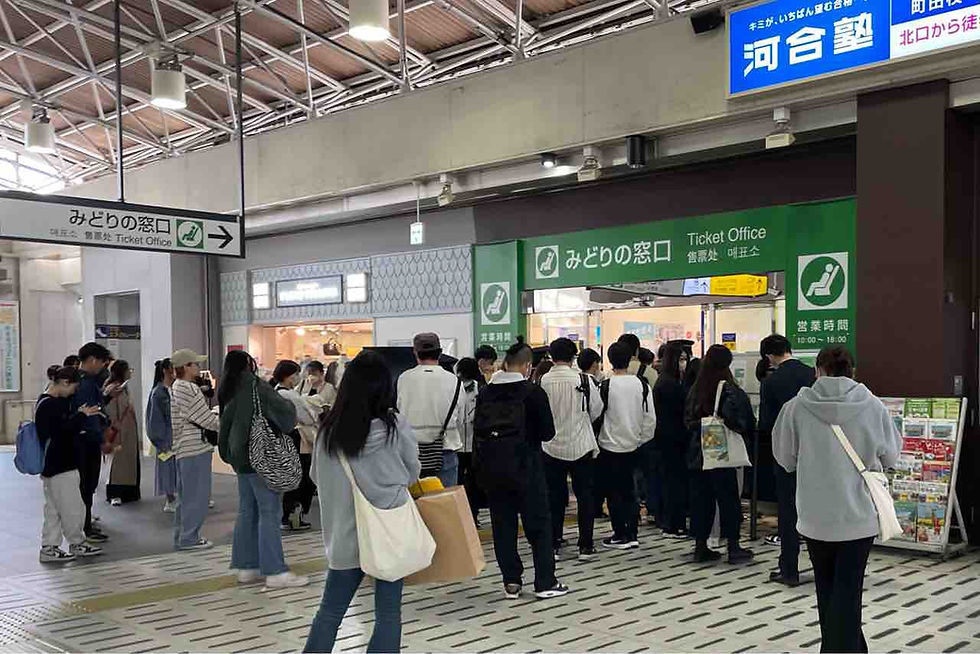
The one-attempt limitation is the real bottleneck here. If your preferred room sells out in the seconds between reaching the counter and 10:00:00, you don't get a real-time second try. You're back of a different line, with a different clerk, hoping for scraps.
Option 2: Book yourself online via e5489 (JR WEST ONLINE TRAIN RESERVATION)
e5489 is JR West's official online booking portal. It has an English interface, which makes it the default first stop for most foreign travelers trying to book the Sunrise Seto or Sunrise Izumo from abroad.
Pros | Cons |
Accessible from anywhere with an internet connection. | Significant latency. Most users report their first successful booking request doesn't go through until roughly 60 to 90 seconds after 10:00:00 JST, a round-trip delay compounded by checkout and payment processing time on top of it, which is often too late for first-class rooms, and during busy periods, second-class rooms too. (This is a widely reported pattern among travelers, not an official JR statistic, but it lines up consistently with how fast popular dates sell out.) |
Same base pricing as booking in person, no service fee. | e5489 card decline issues are common. Japan's 3D Secure (3DS) requirements for online payments are strict, and many non-Japanese-issued cards are rejected at checkout |
Tickets release at 10:00 AM Japan time, which is 2:00 AM in London, 3:00 AM in Berlin, and 9:00 PM the previous day in New York. You're competing for limited inventory while much of the world is asleep | |
Minimal customer support in languages other than Japanese if something goes wrong | |
You must collect your physical ticket at a station ticket machine using the same physical credit card used to book, so virtual cards or one-time-use numbers won't work for pickup, even if they worked at checkout | |
No waitlist. If your date sells out, your only option is to manually refresh e5489 yourself, repeatedly, hoping a cancellation appears before someone else grabs it. |
Why the latency matters more than it sounds like it should: unlike a MARS terminal sitting on JR's dedicated network, e5489 runs over the ordinary public internet, so every request from outside Japan makes a real round trip across the Pacific or from Europe and back, before checkout processing even begins. On a train where rooms can disappear within a minute or two of release, that combined delay is frequently the difference between a confirmed first-class room and an already-sold-out category.

Who this works for: Travelers comfortable staying up at an inconvenient local hour, who have a physical, foreign-transaction-friendly card they'll be carrying in Japan, and who are willing to accept meaningfully worse odds for private rooms in exchange for not needing to be in the country.
Want to see what your odds are booking tickets by yourself? Use our Sunrise Express Booking Success Calculator to get an estimated probability of securing rooms on your requested date.
Option 3: Book through Sunrise Express Tickets
This is what we do, and it's built directly to solve the two structural problems above: the one-shot nature of the ticket counter, and the latency and card-decline problems of e5489. If you've been searching how to book Sunrise Express tickets with anything resembling certainty, this is the gap we exist to close.
Pros | Cons |
Highest success rate of the three methods: 93% over the trailing 12 months, calculated across completed bookings for a customer's first-choice room and date, and not counting cases where a customer cancelled before the sale date | More expensive than booking it yourself, since you're paying for the labor of multiple runners working your request at once |
A distributed network of runners stationed at ticket counters around Japan, away from the most contested Tokyo counters, doing exactly what Option 1 requires (waiting at the counter, submitting at 10:00 AM over the same dedicated MARS network) but with far less local competition for that specific counter | Even with this approach, there's roughly a 7% failure rate for a customer's exact first-choice room and date. Multiple simultaneous attempts improve odds significantly, but don't make them 100% |
Small refundable deposit (around $30) upfront, refunded in full if we can't secure your room. No staying up at 2 AM gambling your own money on an uncertain outcome | |
A real waitlist, run by us. With Option 1, waitlisting means physically returning to the counter yourself. With Option 2, it means manually refreshing e5489 yourself, indefinitely. With us, you tell us what you want once, and we actively monitor availability and notify you the moment something opens up | |
Direct phone and email support, plus the ability to modify dates or room types after booking | |
Tickets shipped to your home address or your hotel in Japan, ready to use, plus support on the day of travel itself | |
You can lock in hotels and the rest of your itinerary before the one-month mark, instead of waiting to see if you even get the Sunrise Express before booking anything else around it | |
Accepts international credit cards, sidestepping the e5489 3DS decline problem entirely, plus other flexible payment options |
This is a pattern we see often enough to be worth mentioning: a traveler tries e5489 themselves on release day, doesn't get the room they wanted, tries again the next day in case of a cancellation, still comes up empty, and only then reaches out to us. In a meaningful share of those cases, we're able to get them exactly the room they were chasing, simply because our runners are working the in-person channel with far less local competition than the flood of e5489 traffic hitting the same train at 10:00 AM. It's not a guarantee, since by that point a date may genuinely be sold out everywhere, but it's common enough that "I tried it myself first" is one of the most frequent reasons people come to us in the first place.

One honest clarification on that 7%: even when we can't secure a customer's first-choice room, we can frequently offer a strong alternative, such as a different room category on the same train. A "failed" first-choice booking usually doesn't mean an empty-handed customer. It means the original ask wasn't fully met.
Furthermore, if your trip is less than a month away, you can see our current availability on our reservation portal.
So which one should you actually use?
If you're already in Japan a month before your travel date and comfortable navigating a Japanese-only counter interaction, Option 1 is genuinely the cheapest route, with no service fee, and the dedicated MARS connection means your request goes in instantly once you reach the window.
If you're booking from abroad, own a physical card that clears Japanese 3DS checks, and can tolerate staying up at an odd hour with no guarantee of success, Option 2 is workable, with the caveat that first-class rooms are a long shot, the public-internet round trip puts you behind anyone on a dedicated line, and a card decline can end your attempt before it starts.
If you want to actually plan your Japan trip around a confirmed Sunrise Express booking rather than build contingency plans around an uncertain one, and you'd rather pay for materially better odds and an active waitlist than gamble your own time and money against a system stacked against solo bookers, that's the gap Sunrise Express Tickets is built to close.
There's no universally correct answer. It depends on how much certainty is worth to you, and whether you can even get into the arena the other two options require to begin with.


Comments